
What Volusia County Probate Records Cover
Probate in Volusia County is a Circuit Court matter. Florida has no separate probate court. The Clerk of the Circuit Court, through its Probate and Guardianship division, keeps the case files, collects fees, issues certified copies, and manages the official record of every probate proceeding filed in the county. The Circuit Court judge assigned to the probate division hears petitions, reviews filings, signs orders, and closes estates.
The Clerk's probate division handles a wide range of case types. Estates go through one of three tracks: formal administration, summary administration, or disposition of personal property without administration. Each track serves a different situation, and the court determines which process fits. Beyond estates, the division also maintains records for caveats filed by interested persons, original wills deposited with the Clerk, trusts brought before the court, and guardianship proceedings for minors and adults who cannot manage their own affairs. Guardianship cases can involve significant personal details, including medical and incapacity findings, and portions of those records may not be open to the public.
Volusia County probate records are separate from family law records, though both sit in Circuit Court. They are also distinct from deed and mortgage filings. If a probate-related document was recorded, it may appear in Official Records. But the probate case file itself is a court record, not an official record, and the Probate and Guardianship division is the place to start.
The Clerk's probate and guardianship page describes what the division maintains and links to the search tools available to the public.
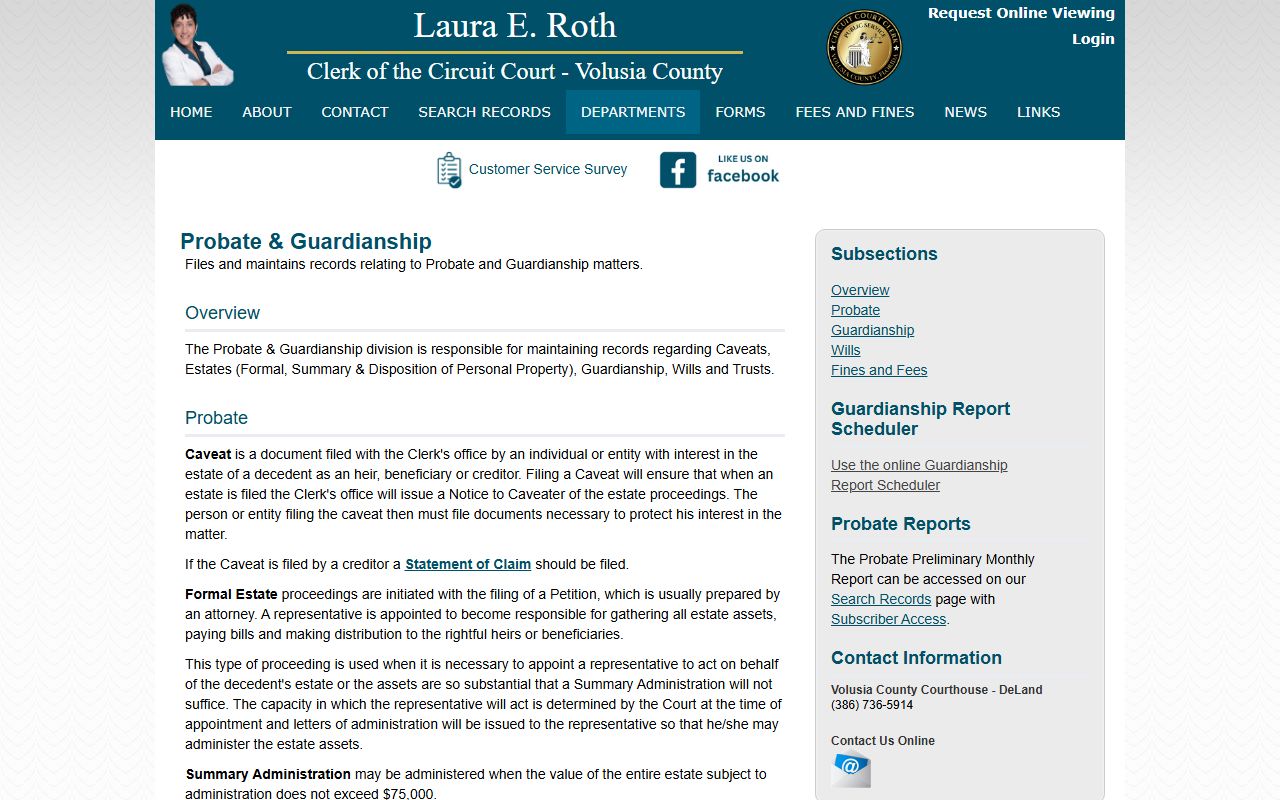
The division's page organizes case types, search options, and fee information in one location, making it a practical first stop before contacting the office directly.
Volusia County Probate Terms Defined
Probate filings use legal terms that appear throughout case records and court orders. Knowing what they mean makes it easier to read a docket entry, understand a notice, or figure out where a case stands. The definitions below match how these terms are used in Florida probate practice.
- Testator
- The person who made a will. When someone dies and leaves a written will, they are called the testator. The will names how the testator wants assets distributed and may appoint a personal representative to carry out those wishes.
- Executor / Personal Representative
- Florida uses the term personal representative rather than executor. The personal representative is appointed by the court and is responsible for gathering assets, paying debts and taxes, and distributing what remains to heirs or beneficiaries. The Circuit Court must approve the appointment.
- Intestate
- Dying without a valid will. When a person dies intestate, Florida's intestacy statutes control how assets pass. The probate court still supervises the administration, but the distribution follows state law rather than the wishes of the deceased.
- Caveat
- A formal notice filed with the Clerk by an interested person, such as an heir, beneficiary, or creditor. Filing a caveat alerts the court that the person wants notice before any action is taken on an estate. Caveats can be filed before or after death and are tracked by the Probate and Guardianship division.
- Summary Administration
- A shorter probate process available in some cases. Summary administration does not require appointment of a personal representative and moves through the court faster than formal administration. The Clerk's office can confirm whether a filed case used this track, but the court determines eligibility.
- Guardianship
- A court-supervised arrangement in which a guardian is appointed to manage the personal or financial affairs of a person who cannot do so themselves. This can involve a minor or an adult whose capacity is at issue. The Circuit Court in Volusia County has authority over guardianship proceedings, and the Probate and Guardianship division keeps those case files.
The 10-Day Will-Deposit Rule in Florida
Florida law places a clear duty on anyone who holds a will after a testator dies. Under Florida Statute 732.901, a custodian of a will must deposit the original will with the clerk having venue of the estate within 10 days after receiving information that the testator is dead. The statute applies to anyone holding a will, not just family members or attorneys.
For most Volusia County estates, venue lies with the Volusia County Clerk. Once the will is deposited, it becomes part of the court record. A will can be deposited without opening a full estate. If no estate is opened at the time of deposit, the will is held on file and may be retrieved later if administration becomes necessary. Failing to deposit a will when required can have legal consequences under Florida law.
The Florida Statute 732.901 page on the Senate website shows the full text of the will-deposit requirement, including the 10-day timeline and the duty placed on custodians.
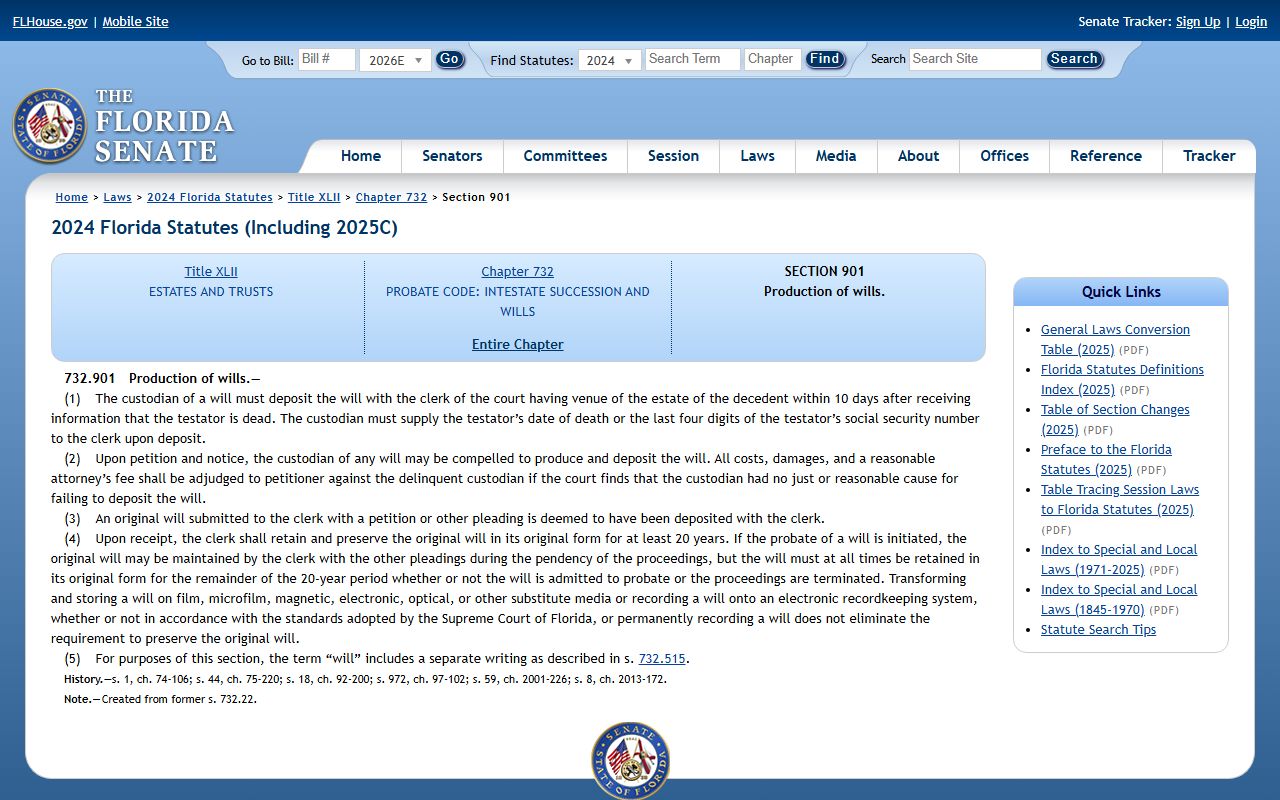
Depositing a will with the Clerk does not automatically open an estate or trigger probate. It simply preserves the document in the official court record for Volusia County.
Note: Depositing a will with the Clerk does not mean probate has been filed; a separate petition is needed to open administration of an estate.
How Volusia County Probate Works
Probate in Volusia County follows a defined sequence, from determining where to file through final court closure. The steps below reflect the process described by the Clerk's Probate and Guardianship division. The order matters because later steps depend on earlier filings being accepted by the court.
- Determine venue in Volusia County. The estate must be filed in the county where the decedent was domiciled at the time of death or, in some situations, where assets are located. Confirm that Volusia County is the correct venue before filing.
- Deposit the original will. If a will exists, the custodian must deliver it to the Volusia County Clerk within 10 days of learning the testator has died, as required by Florida Statute 732.901. Even if no estate will be opened right away, the will must still be deposited.
- File the correct estate petition. Choose the right track: formal administration, summary administration, or disposition of personal property without administration. Each has its own petition form. The Clerk's office can tell you which forms apply.
- Pay filing fees and submit required documents. Along with the petition, the filing usually includes a death certificate, proposed orders, oath or designation of personal representative, and any required notices to interested persons. Filing fees are paid to the Clerk at the time of submission.
- Court reviews and approves appointment. For formal administration, the court reviews the petition and supporting documents, then enters an order appointing the personal representative. For summary administration or disposition of personal property, the court reviews and may grant the petition without a separate appointment.
- Publish and serve creditor and interested-person notices. Florida probate law requires notice to creditors and, in formal administration, publication of a notice to creditors in a local newspaper. Interested persons must also receive notice as required. Proof of publication and service is filed with the Clerk.
- File inventory, accounting, and distribution documents. In formal administration, the personal representative must file an inventory of estate assets and, where required, accountings showing receipts, disbursements, and proposed distributions. Documents reflecting the handling of creditor claims and the distribution of assets to beneficiaries are also filed with the Clerk.
- Close the estate by court order. After administration is complete and all required documents are filed, the personal representative petitions the court to close the estate. The court reviews the final accounting and distribution and, if satisfied, enters an order of discharge that closes the case.
Search Volusia County Probate Records Online
Probate case records in Volusia County are searched through the same Case Inquiry portal used for civil and criminal matters. The Clerk's Case Management System lets you search by party name or case number and filter by case type. For probate, select the Probate option in the Case Type dropdown. Results show the case number, filing date, parties, and docket entries. Some document images may be available online; others require a request to the Clerk.
A second tool, the Probate Preliminary Monthly Report, lists estates filed during the prior month and is generated on the seventh day of every month for Department of Revenue reporting purposes. That report requires Subscriber Access, which is a higher permission level not available to the general public. Ordinary searches go through Case Inquiry. If you cannot find what you need online, the Probate and Guardianship division can assist with in-person or written requests.
| Field Label | Type | Required | Notes / Format |
|---|---|---|---|
| Name | Text | Optional if case number used | Can be decedent, estate name, guardian, ward, or any party or interested person. |
| Case Number | Text | Optional if name used | Use the full Volusia case number if you have it. |
| Case Type | Dropdown | No | Select Probate to narrow results to probate and guardianship cases. |
| Probate Preliminary Monthly Report | Report link | N/A | Requires Subscriber Access. Not available to general public. |
Note: Case Inquiry is for informational use only; online data is not the official record, and certified copies must be purchased from the Clerk.
Volusia County Probate Records Fees
The Clerk's fee schedule lists specific charges for probate-related services. Fees apply to filings, copies, searches, and certain petition types. The table below shows the fees listed on the Clerk's fees and fines page for probate matters. All fees are paid to the Volusia County Clerk of the Circuit Court at the time of the transaction.
| Item | Fee |
|---|---|
| Petition or order to admit foreign wills, authenticated copies, exemplified copies, or transcript to record | $231.00 |
| Certified copy | $2.00 certification fee plus copy fee |
| Search per name per year | $2.00 |
| Standard copy | $1.00 per page |
Staff-conducted searches cost $2 per name per year searched. If you know the case number, you can avoid the search fee by providing it directly. For certified copies, the $2 certification charge is added on top of the per-page copy fee. Bring or send exact payment when requesting copies by mail.
What Volusia County Probate Records Show
A probate case file can contain a wide range of documents depending on what type of administration was used and how far the case progressed. The filing date, parties, petition type, and docket entries all appear in the public case record. For open estates, you can often track the status through filed documents such as orders of appointment, inventory, accountings, creditor notices, and distribution filings.
Wills deposited with the Clerk become part of the court file and may appear in the docket. Caveats are indexed by the name of the interested person and the estate. Trust matters brought before the court are also part of the probate file. Guardianship cases show the appointment of a guardian, annual reporting filings, and any court orders about the ward's care or finances, though detailed personal reports may be restricted.
Not every document in a probate file is visible online. Some items require a direct request to the Clerk. In-person review at the courthouse allows access to the full public portions of a case file. Certified copies are available by request and payment. For public records requests beyond court case files, such as recorded probate-related deeds or instruments, the Official Records division of the Clerk is the right office.
Restricted Volusia County Probate Records
Guardianship records can contain confidential information. Medical findings, incapacity evaluations, financial details, and ward information may be part of a guardianship file, and Florida law and court rules can limit public access to those materials. Public summaries or basic docket entries may be available, but detailed guardianship reports and clinical records are often restricted.
Florida Rule of General Practice and Judicial Administration 2.420 governs confidential information in judicial branch records. Protected identifiers, financial account data, and certain personal information must be redacted from public filings. If a guardianship case file appears incomplete or certain documents are absent online, the restriction may be intentional under court rules. The Clerk can explain what portions of a file are open to the public and what requires attorney or party status to access.
Mental health proceedings that arise in connection with guardianship or incapacity determinations may also involve records protected under Florida Statute 394.4615, which covers clinical mental health records. Those records are not part of the ordinary public court file.
Volusia County Probate and Guardianship Division
The Probate and Guardianship division operates under the Clerk of the Circuit Court. Filings, fee payments, certified copy requests, and will deposits all go through the Clerk's main courthouse office. For questions about a specific probate case or the filing process, the Clerk's office is the right contact. The Clerk of the Circuit Court page has more on the office's full range of services.
Volusia County Clerk of the Circuit Court
Volusia County Courthouse
101 North Alabama Avenue
DeLand, FL 32724
Mailing: P.O. Box 6043, DeLand, FL 32721-6043
(386) 736-5915
Open weekdays; confirm hours before visiting