
Volusia County Arrest Records Overview
An arrest record is created the moment a person is booked into jail. In Volusia County, the Volusia County Division of Corrections runs the jail facilities. That office is separate from the Volusia Sheriff's Office, even though the Sheriff's Office makes many of the arrests. Booking data flows to the public inmate inquiry site at volusiamug.vcgov.org. Each booking entry includes the person's name, mugshot, booking date, charges, bond information, arrest case number, and court case number if one has been assigned. Local police agencies can also bring arrestees to the Volusia jail, so the roster covers more than just Sheriff's Office arrests.
A criminal court record is a different file held by a different office. Once the State Attorney files charges, the Clerk of the Circuit Court opens a case in the case management system. That record contains the charging document, docket entries, motions, orders, plea, sentencing, and any financial obligations. For the full case file, the Clerk's Case Inquiry portal is the right tool. For the arrest booking side, the inmate inquiry site covers recent activity. Both are public, but each shows a different slice of the same event. See Volusia County court records for full case history and certified copy requests.
The Clerk's criminal records page links directly to the Case Inquiry tool, the daily Arrest/Booking Download, and the seal and expunge filing information. That page is a good starting point when you need both the court and the booking side of a search.
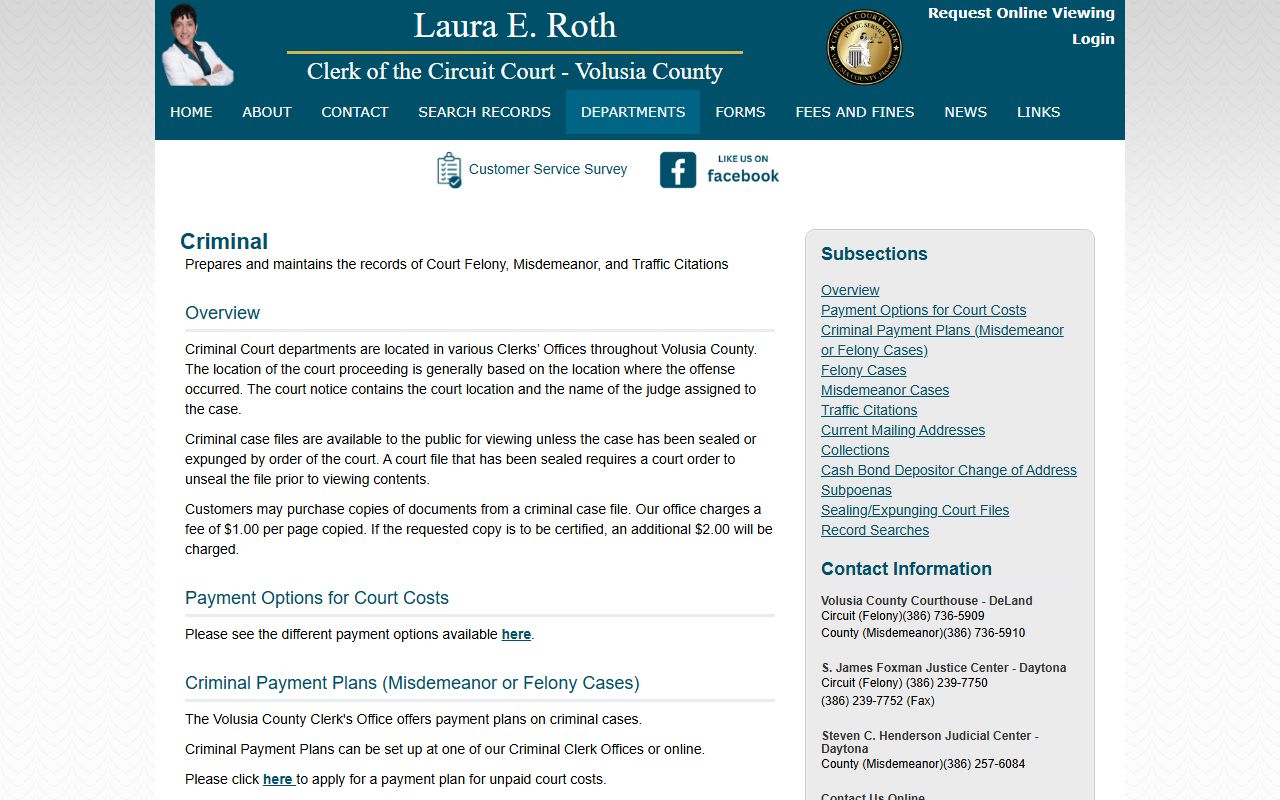
From that page, the Case Inquiry link takes you into the Clerk's Case Management System, where criminal cases appear alongside civil, family, and probate records under the same search form.
How to Search Volusia County Criminal Records
There are three main tools for a Volusia County arrest or criminal records search. The Clerk Case Inquiry covers court cases. The daily Arrest/Booking Download covers recent booking data. The inmate inquiry at volusiamug.vcgov.org covers current and recent jail rosters. Each tool serves a different need, and using the right one saves time.
- Go to the Clerk's criminal records page and click Case Inquiry. Accept the public disclaimer, then search by name or case number. Use the Criminal case type filter to narrow results. Case Inquiry shows docket entries, charges, and dispositions for cases filed in the Volusia Circuit and County Courts.
- For recent booking data, use the daily Arrest/Booking Download on the same Clerk criminal page. The download covers the prior 24 hours by default. The Clerk states data is available for roughly a 14-day window. The file format shows booking date, name, charges, arrest agency, and case numbers. It is a flat data file, not a searchable portal.
- To look up a specific person in current or recent jail custody, use the inmate records inquiry at volusiamug.vcgov.org. Search by last name, first name, or six-digit booking number. Check the archive box to reach older entries.
- For a statewide criminal history record, contact the Florida Department of Law Enforcement. FDLE maintains the Florida Crime Information Center and handles criminal history background checks for the state. That search is separate from anything the Clerk or jail holds locally.
Warrant-related records have their own path. The Clerk's Case Inquiry may show capias entries in a criminal case docket, which signals a court-issued arrest order after a missed appearance. For a broader warrant search, the Volusia County warrant records page covers that process in detail.
Arrest Record vs. Criminal Court Record in Volusia County
These two things often get confused because they involve the same person and the same event. But they come from different agencies and carry different information. The arrest record is generated by law enforcement and the jail. It exists as soon as someone is booked. The criminal court record is generated by the Clerk after the State Attorney files charges. No charge filing means no court record. The table below shows the key differences.
| Arrest Record | Criminal Court Record | |
|---|---|---|
| Custodian | VSO / Volusia County Division of Corrections | Clerk of the Circuit Court |
| Created When | At booking into jail | When charges are filed in court |
| Key Contents | Mugshot, booking date, booking charges, bond, arrest case number | Charging document, docket, plea, orders, sentence, financial obligations |
| Main Search Tool | Inmate inquiry / booking download | Clerk Case Inquiry |
| Charges Reflect | Booking charges set at arrest | Filed charges, which may differ after State Attorney review |
The booking charge is what law enforcement recorded at intake. The State Attorney may later file the same charge, amend it to a lesser or greater offense, or decline to prosecute entirely. So a booking record showing a felony charge may ultimately result in a misdemeanor court case, or no case at all. The court docket is the more reliable source for what actually happened legally.
Note: Online booking and court data is informational only. Both agencies warn that their online records are not the official record and may lag or omit data.
Volusia County Criminal Records: Charges vs. Convictions
A charge is not a conviction. This distinction matters more in Florida than in many states because arrest records and booking data are broadly public. Anyone can see that a person was charged with a crime. That visibility does not mean guilt was established. A charge is a formal accusation. A conviction requires proof beyond a reasonable doubt, entered through a verdict or a guilty plea.
| Charge | Conviction | |
|---|---|---|
| Legal Stage | Accusation or information filed | Verdict or accepted guilty/no-contest plea |
| Standard Required | Probable cause to arrest or file | Proof beyond a reasonable doubt |
| Who Decides | Law enforcement and State Attorney | Judge or jury |
| Appears in Court Record | Yes, as a filed count | Yes, as a disposition entry |
| Case Can End Without Conviction | Yes | N/A |
A case can end many ways short of conviction. Charges may be dismissed with or without prejudice. Nolle prosequi means the State Attorney drops the case. A not-guilty verdict means acquittal. Each of these dispositions still leaves a court record, and the prior charge may still appear in booking data. Understanding the disposition field in Case Inquiry helps avoid misreading a case outcome.
Sealing and Expungement of Volusia County Criminal Records
Florida law gives some people the right to seal or expunge a qualifying criminal record. Sealing hides a record from ordinary public access but does not destroy it. Expungement goes further and removes the qualifying criminal history from public access more completely. Both require meeting statutory criteria, obtaining FDLE approval, and filing with the Clerk.
The process starts with the Florida Department of Law Enforcement. FDLE reviews eligibility and, if criteria are met, issues a Certificate of Eligibility. Common reasons for denial include an ineligible offense type, a prior sealing or expungement, unresolved charges in another case, a conviction that disqualifies the applicant, or missing paperwork. The statutes governing this are Florida Statute 943.0585 for expungement and Florida Statute 943.059 for sealing.
Once FDLE issues the certificate, the applicant files the full petition package with the Clerk in the underlying criminal case. The Volusia County Clerk's criminal page states the filing fee is $42. Copy and certification fees apply separately if the petitioner wants certified copies of the resulting order.
The FDLE seal and expunge page explains the eligibility criteria and application steps in full.
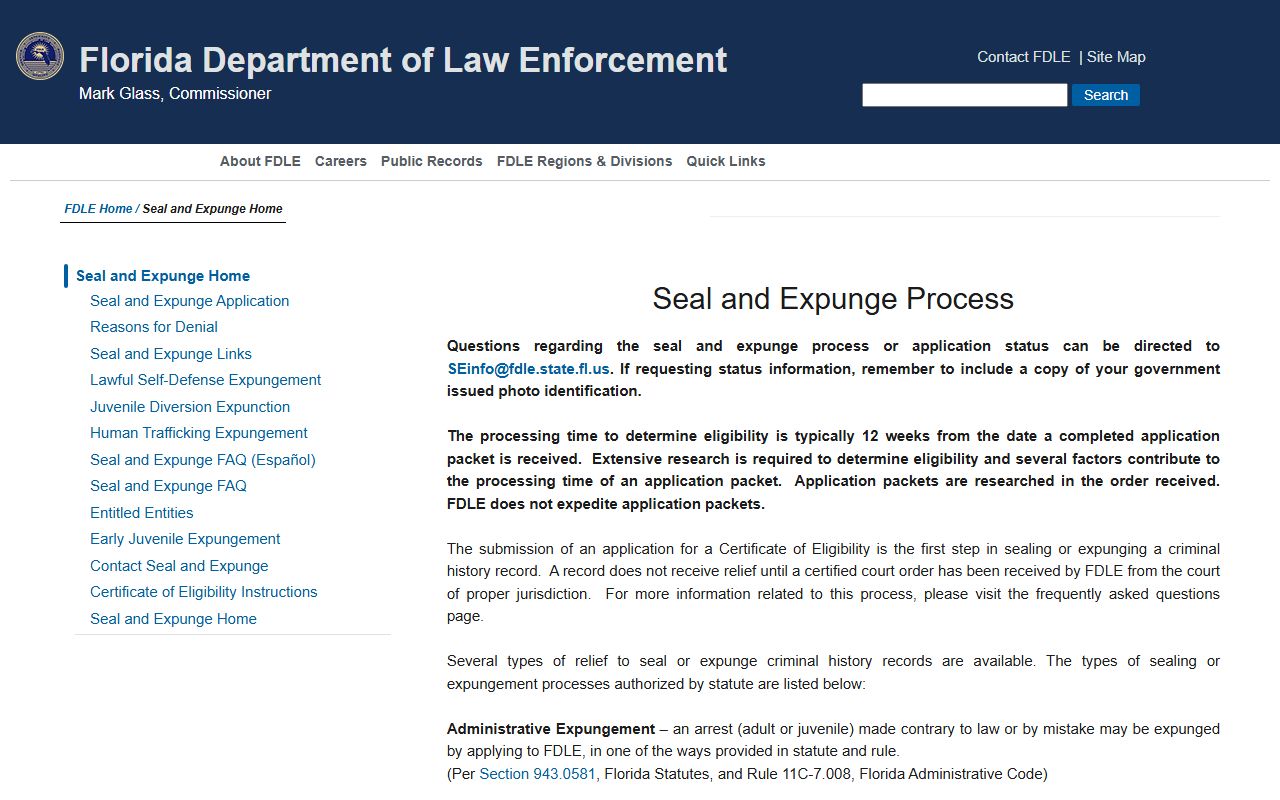
FDLE administers eligibility; the Volusia Clerk processes the court filing and maintains the resulting order.
How to File a Seal or Expunge Petition in Volusia County
- Apply to FDLE for a Certificate of Eligibility. FDLE will confirm whether the record and the applicant meet the criteria under Florida Statute 943.0585 or 943.059.
- Prepare the petition. The petition must include a sworn statement by the applicant, a proposed order for the judge to sign, and the original FDLE Certificate of Eligibility.
- File the full package with the Volusia County Clerk of the Circuit Court in the criminal case. The Clerk's filing fee is $42. Bring or mail the originals.
- The Clerk routes the petition to the judge assigned to the case. If granted, the court issues the order directing all agencies to seal or expunge the record.
- Serve the order on all agencies listed. Each agency handles its own records separately. FDLE updates the state criminal history file after receiving the order.
Eligibility rules are specific and change based on charge type, prior history, and case outcome. An attorney or legal aid organization can help determine whether a particular record qualifies. Nothing here is legal advice about whether any specific case is eligible.
Sealed vs. Expunged Records: Key Differences
People often use these terms interchangeably, but they are different legal outcomes. Sealing and expungement both restrict public access, but the scope of access and what happens to the underlying record differ in important ways under Florida law.
| Sealed (F.S. 943.059) | Expunged (F.S. 943.0585) | |
|---|---|---|
| Public Visibility | Hidden from ordinary public inspection | Removed from public access more completely |
| Record Exists | Yes, maintained but restricted | Physical record generally destroyed or expunged from agency files |
| Agency Access | Certain agencies may access under statutory exceptions | Very limited agency access; fewer exceptions than sealing |
| Court Docket | Case may still appear as "sealed" in Clerk system | Case treated as if it never occurred for most purposes |
| FDLE Step Required | Yes, Certificate of Eligibility first | Yes, Certificate of Eligibility first |
| Clerk Filing Fee | $42 | $42 |
If a Case Inquiry search does not show a case or document you expect to find, it may be sealed, expunged, confidential by statute, not yet indexed, or simply entered with a different name spelling. The Clerk can confirm access procedures but cannot disclose the contents of sealed or expunged matter. Viewing a restricted record requires party or attorney status, a court order, or elevated access under court rules.
Volusia County Daily Arrest and Booking Download
The Clerk makes a daily Arrest/Booking Download available on the criminal records page. This file covers the prior 24 hours of booking activity and is typically available within the 14-day rolling window the Clerk supports. It is not a searchable database. It is a flat data file listing each booking record from the period. Each row in the download includes the booking date, the person's name, the charges, the arresting agency, the arrest case number, and the court case number if one has been assigned at that point.
The daily download is useful for verifying a recent arrest or checking overnight booking volume. It is not the same as the ongoing inmate roster. For a current in-custody search, the inmate inquiry at volusiamug.vcgov.org is the better tool. Jail booking is handled by the Volusia County Division of Corrections, which is separate from the Volusia Sheriff's Office even when the Sheriff makes the arrest. See Volusia County inmate records for the full booking profile fields and jail contact information.
What a Volusia County Jail Booking Profile Shows
Each booking profile in the inmate inquiry system carries more data than the daily download. The public profile for a current or recent inmate includes the mugshot, an inmate ID number, the booking number, the booking date and time, the release date if applicable, the person's name and residence city, age, race, and sex. The charge information table is the most detailed part of the profile.
That table lists each charge by number, statute, statute description, bond type, bond amount, bond number, arrest case number, court case number, disposition, and charge status. It also shows two extra statute fields for cases where a charge carries secondary statute references. Below the charge table, the profile has an alias section, a scars/marks/tattoos section, and a booking history section listing prior bookings with dates, case numbers, and charge counts. Holding location and court date are not shown in the public profile. Bond information is available from the Branch Jail Booking Office at (386) 254-1555, which is open around the clock.
Note: The court case number in the booking profile and the case number in Clerk Case Inquiry are the same identifier. Use it to cross-reference between both systems.
State Attorney and Public Defender in Volusia County
Florida uses State Attorney rather than District Attorney. Volusia County sits in the Seventh Judicial Circuit, and the State Attorney is R.J. Larizza. The office prosecutes felonies, misdemeanors, juvenile delinquency, and criminal traffic matters. The Daytona Beach office handles Volusia-area prosecutions. Questions about whether charges were filed or what a prosecutor decided belong to the State Attorney, not the Clerk. The State Attorney's website is sao7.com and the Daytona Beach office page is at sao7.com/daytona-beach-office/.
The Office of the Public Defender for the Seventh Judicial Circuit represents eligible indigent defendants at no cost to them. Inmates in the Volusia jail can reach the Public Defender's Office through an open phone line in the housing areas, through a written request form, or by letter. Requests are picked up daily. The Public Defender's website is pd7.org. Legal aid organizations serving the area include Community Legal Services of Mid-Florida at legalaid.org and FloridaLawHelp at floridalawhelp.org.
Restricted Volusia County Criminal Records
Not all criminal records are public. Juvenile delinquency records are restricted under Florida Statute 985.04. Dependency records carry protections under Florida Statute 39.0132. Access to either category is limited to parties, attorneys, agencies, and persons with statutory authorization. Adoption records are confidential under Florida Statute 63.162. Mental health clinical records are protected under Florida Statute 394.4615.
Sealed and expunged records are restricted after a court order under Florida Statutes 943.0585 and 943.059. Grand jury material and sealed warrants are not public until law allows disclosure. Under Florida Rule of General Practice and Judicial Administration 2.420, victim information, protected financial identifiers, and certain domestic-violence safety data are confidential in court files regardless of whether the case is sealed.
Warrants and capias orders are a separate category. A capias is a court-issued arrest order, often entered when a defendant misses a court date. Capias entries may appear in a criminal case docket through the Clerk's Case Inquiry, but active sealed warrants are not searchable publicly. Visit Volusia County warrant records for the full warrant search process.
The Volusia Sheriff's Office handles arrest reports, civil process, and law-enforcement public-records requests. The Volusia Sheriff's Office website has a public records portal for requesting VSO records.
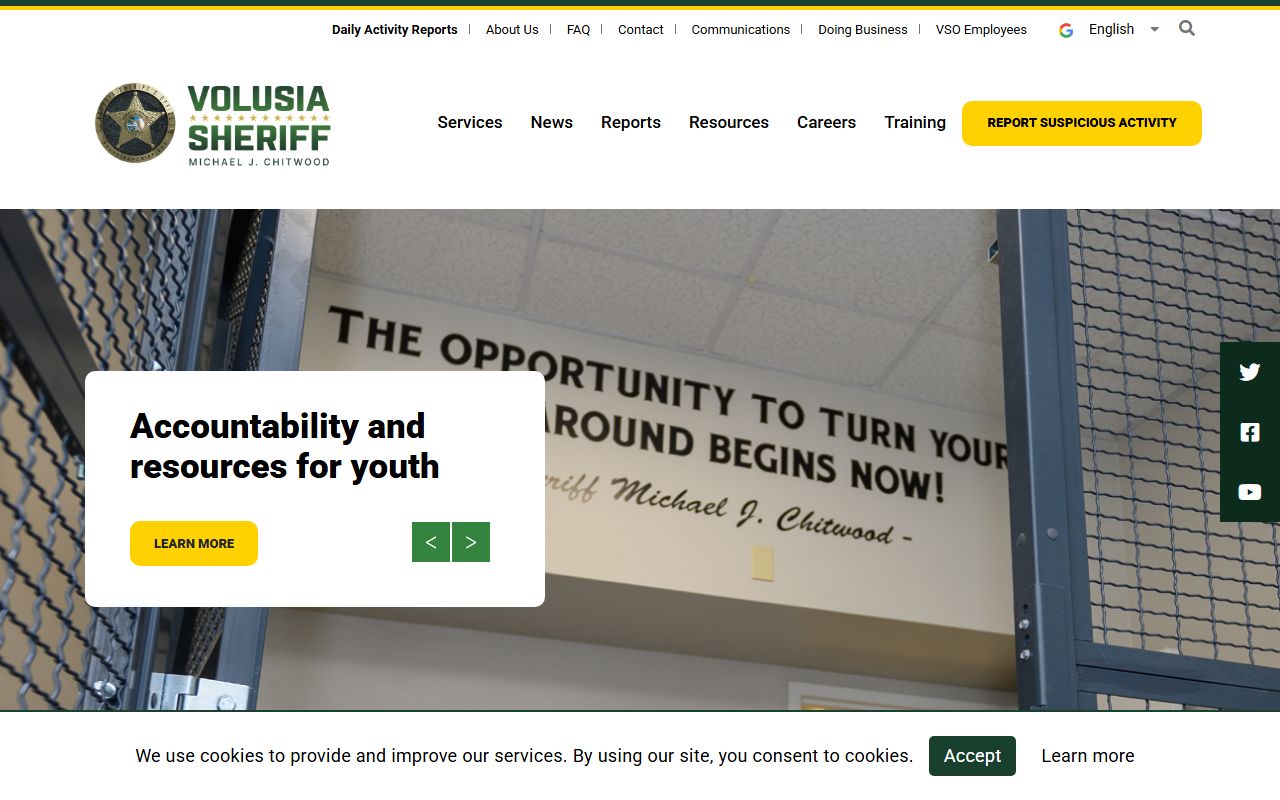
For arrest reports and law-enforcement records, use the VSO public records portal rather than the Clerk's system, since the two offices are different custodians of different records.
DUI and Criminal Traffic Records in Volusia County
DUI cases are criminal matters in Florida. They are filed in Circuit or County Court and appear in the Clerk's Case Inquiry under the criminal case type rather than the Citation Inquiry used for ordinary traffic tickets. A DUI arrest generates a booking record in the jail system and a separate court case once the State Attorney files charges. The same two-custodian structure applies. Volusia County traffic court records for non-criminal violations use Citation Inquiry, which covers violations from January 1, 1990 forward. DUI will not appear there.